50 Spring Brain Activities for Kids (Screen-Free & Printable Ideas for Ages 6–12)

Spring brings longer days, more outdoor energy, and a sudden burst of curiosity in children. But it also brings rainy afternoons, unpredictable weather, and the familiar phrase:
“I’m bored.”
If you’re searching for spring brain activities for kids that are screen-free, educational, and actually engaging — this guide gives you structured ideas that build focus, logic, creativity, and independent thinking.
These activities are perfect for:
- Spring break at home
- Homeschool days
- Classroom quiet time
- Rainy afternoons
- Travel and waiting rooms
Inside this guide you’ll find 50 structured activities across language, logic, craft, movement, and printable challenges — all designed for ages 6–12.
Why Brain-Based Activities Matter in Spring
Spring often increases children’s physical energy. The key is pairing that energy with constructive mental challenges.
High-quality brain activities help children:
- Strengthen vocabulary and spelling
- Improve concentration
- Build logical reasoning
- Develop persistence
- Practice independent problem-solving
Short structured challenges create a powerful loop:
challenge → attempt → small success → motivation → repeat
That loop builds long-term thinking habits.
How to Use This List
Instead of trying everything at once:
• Choose 2–3 activities per day
• Mix one quiet task + one movement task
• Rotate language, logic, and creative work
• Use printables for independent time
Even 20–30 focused minutes daily creates noticeable growth in attention and confidence.

Get your free Spring Brain Boost Pack — 3 worksheets that build focus and vocabulary!
SPRING WORD & LANGUAGE CHALLENGES (Ages 6–12)
These activities build vocabulary, spelling confidence, and creative language use — without feeling like schoolwork.
1. Spring Word Search (Ages 6–8)
12 short seasonal words.
2. Spring Word Search Challenge (Ages 8–12)
Best for ages 8–12
A structured spring word search activity helps children strengthen spelling patterns while improving focus and persistence. Use longer seasonal words like blossom, rainfall, garden, butterfly, or sunshine to increase challenge level.
Set a 10-minute timer and challenge your child to find all 12 words before time runs out. For an extra difficulty boost, ask them to use three of the words in a complete sentence afterward.
3. Word Ladders – Spring Edition
Best for ages 6–9
Change one letter at a time to “grow” the word.
Spring word ladders for kids are perfect for early readers learning how small letter changes create new words.
Example ladder:
seed → need → reed → read
4. Outdoor Alphabet Hunt (Ages 6–9)
Find one object for every letter.
5. Build-a-Sentence Challenge (Ages 7–12)
Use 5 random spring words in one creative sentence.
6. Spring Riddle Writing (Ages 8–12)
Create your own seasonal riddle.

7. 5-Minute Poetry Sprint (Ages 9–12)
Write a short spring poem in 5 minutes.
8. Secret Garden Code Message (Ages 8–12)
Best for ages 8–12
Coding games strengthen analytical thinking and perseverance.
Example code:
2-12-15-15-13
Provide an alphabet key (A=1, B=2…) and let your child decode the hidden word: BLOOM.
Encourage them to create their own secret spring message afterward.
9. Word Scramble Relay (Ages 7–10)
Unscramble seasonal words under time pressure.
10. Vocabulary Card Craft (Ages 6–10)
Create flashcards from outdoor objects.
11. Spring Synonym Match
Match seasonal words with similar meanings.
12. Sentence Builder Cards
Create funny spring sentences from 3 random word cards.
13. Spring Word Scramble
Unscramble the mixed-up letters to discover hidden spring words.
Each puzzle challenges kids to recognize patterns, test spelling knowledge, and think flexibly.
From flowers and animals to weather and outdoor activities, these scrambled words keep young minds alert and engaged.
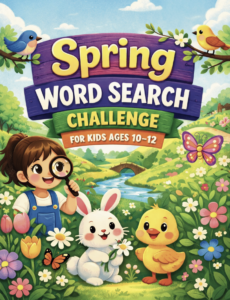
Spring Word Search Challenge for Kids Ages 10–12
For older kids ready for deeper vocabulary challenges, Spring Word Search Challenge for Kids Ages 10–12 offers 80 carefully designed puzzles that gradually increase word length and complexity.
These structured challenges help improve concentration, reinforce spelling patterns, and develop scanning skills — all within fun, spring-themed layouts that keep learning engaging.
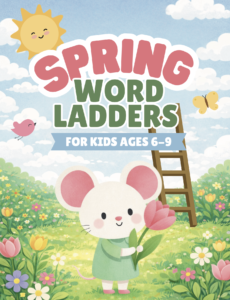
Spring Word Ladders for Kids Ages 6–9
If your child enjoys step-by-step word challenges, Spring Word Ladders for Kids Ages 6–9 offers fun 3–5 letter puzzles that build vocabulary, spelling confidence, and logical thinking — one letter at a time.
Each ladder encourages children to focus, experiment, and discover how small changes create new words, making it perfect for independent practice, quiet time, or early finishers in the classroom.
LOGIC & THINKING BUILDERS (Ages 7–12)
Structured reasoning improves executive function.
14. Garden Maze Challenge
Best for ages 6–10
Maze puzzles help children develop forward planning and attention to detail.
Create a printable garden maze where a bee must reach a flower without crossing thorns. After solving it, ask:
“What was the fastest path? Could there be another solution?”
15. Picture Sudoku
Best for ages 6–10
Picture Sudoku uses spring-themed images instead of numbers, helping kids practice logical thinking and visual patterns in a fun, age-appropriate way.
16. Pattern Builder
Continue shape or color patterns.
17. Build-Your-Own Maze
Design and test it.
18. Odd-One-Out Nature Game
Which item doesn’t belong? Why?
19. Memory Tray – Outdoor Edition
Observe → remove → recall.
20. Direction Code Walk
Follow written instructions outside.

21. Logic Match Puzzle
Match people to activities.
22. Mini Engineering Challenge
Best for ages 8–12
STEM-style spring challenges help build resilience.
Build the tallest tower using only 5 sheets of paper and tape.
Afterward ask:
“What shape made your tower strongest — cylinder, triangle, or square?”
23. Shape Symmetry Drawing
Fold paper and design symmetrical butterflies.
24. Pattern Grid Puzzle
Complete a repeating visual pattern.
25. Shadow Match Game
Best for ages 6–9
Match spring objects to their shadows.
26. Spring Strategy Tic-Tac-Toe
Play the classic game with a spring theme twist.
Two players take turns placing their symbols on the grid, trying to get three in a row — horizontally, vertically, or diagonally.
Simple to learn but surprisingly strategic, this game encourages players to think ahead, block opponents, and plan their moves carefully.
See Activity Aces Books on Amazon
CREATIVE SPRING CRAFT & CONSTRUCTION (Ages 6–12)
Creative building strengthens flexible thinking.
27. Treehouse Blueprint Design
Best for ages 7–11
Designing a blueprint encourages structured thinking before building.
Example challenge:
Draw a treehouse with three labeled rooms:
• Reading corner
• Secret lookout tower
• Rope bridge entrance
Ask: “How will someone enter safely? What materials will you use?”
28. Build a Paper Kite
Decorate and test balance.
29. Create a Mini Paper Garden
Cut and assemble flowers.
30. Invent a New Flower Species
Draw + describe habitat.
31. Spring Comic Strip
Story about a curious bee.
32. Nature Collage
Use safe materials outdoors.
33. DIY Bird Feeder
Recycled materials.
34. Cardboard Rain Shelter Test
Will it keep a toy dry?

35. Spring Board Game Design
Best for ages 8–12
Designing a board game strengthens executive function. Create rules and movement spaces.
Example instructions:
• Create a 20-square path
• Add “move forward 2” or “solve a riddle” squares
• Include one “rainstorm setback” space
Ask:
“What makes your game fair? What makes it challenging?”
36. Butterfly Mobile Craft
Design + balance hanging pieces.
37. Iris Folding – Spring Card Design
Best for ages 8–12
Iris folding is a paper craft technique where strips of colored paper are layered behind a cut-out shape in a spiral pattern. Kids can create a flower, butterfly, or egg silhouette and carefully layer paper strips to form a geometric spiral design.
This activity strengthens sequencing skills and patience while introducing structured artistic design.
Cut a simple tulip shape from cardstock. Behind it, layer pastel paper strips in a spiral pattern, following a numbered guide (1–8). When finished, remove the template to reveal a beautiful spring design.
38. Design a Spring Mascot
Invent and describe a character that represents spring.
MOVEMENT + BRAIN ENERGY ACTIVITIES (Ages 6–12)
Physical motion improves cognitive engagement.
39. Alphabet Hop Challenge
Best for ages 6–8
Jump while spelling words.
Call out a letter. The child must jump and say a spring word starting with that letter.
Example:
“B!” → “Bloom!”
40. Math Jump Game
Solve before each hop.
41. Outdoor Color Hunt
Find objects by color.
42. Freeze & Focus Game
Run → freeze → solve quick puzzle.
43. Balance & Spell
Balance on one foot while spelling.
44. Shape Hunt Outdoors
Find natural shapes.

45. Treasure Hunt with Clues
Skill: sequential reasoning.
46. Timed Sorting Challenge
Sort by size or type.
47. Simon Says (Logic Edition)
Add mental tasks.
48. 5-Minute Focus Sprint
Short timed concentration challenge.
49. Spring Action Dice Game
Roll a die with actions like jump, spell, clap.
50. Nature Measurement Walk
Estimate and measure objects outdoors.
PRINTABLE SPRING ACTIVITIES
Structured printables are ideal for independent work.
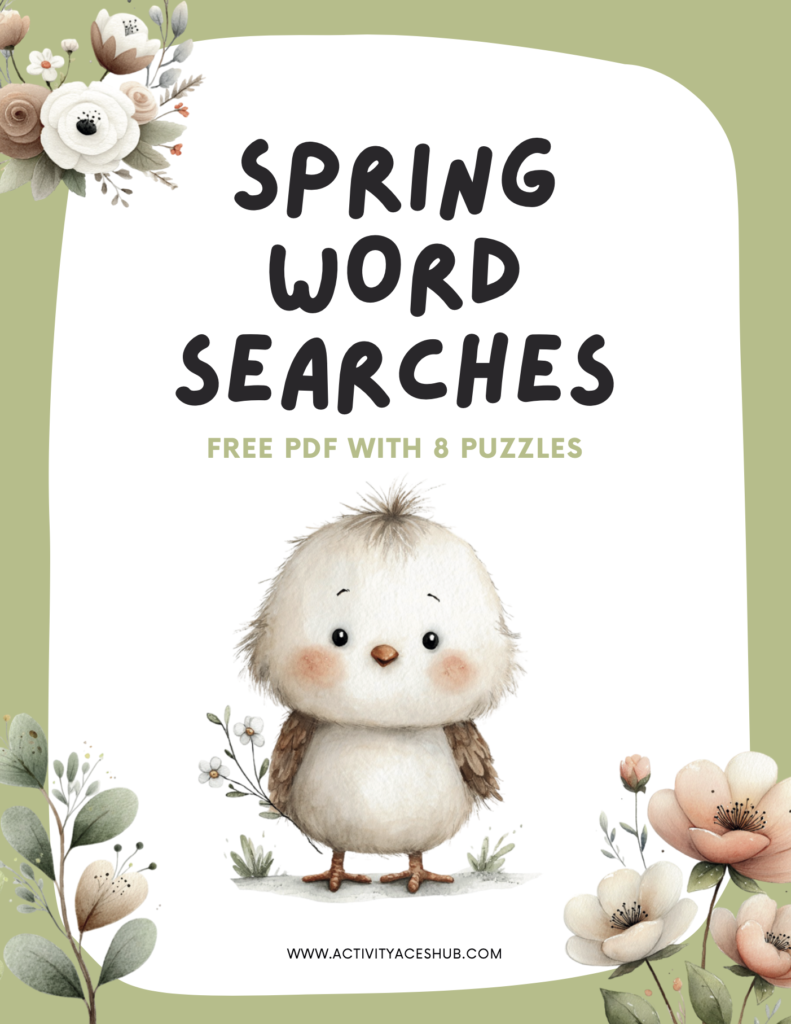
Free Spring Word Search Printable
This printable includes 8 carefully selected spring-themed words designed to build vocabulary, spelling confidence, and focus — without overwhelming younger learners.
Perfect for independent quiet time, early finishers, or a quick 10-minute brain boost during spring break.
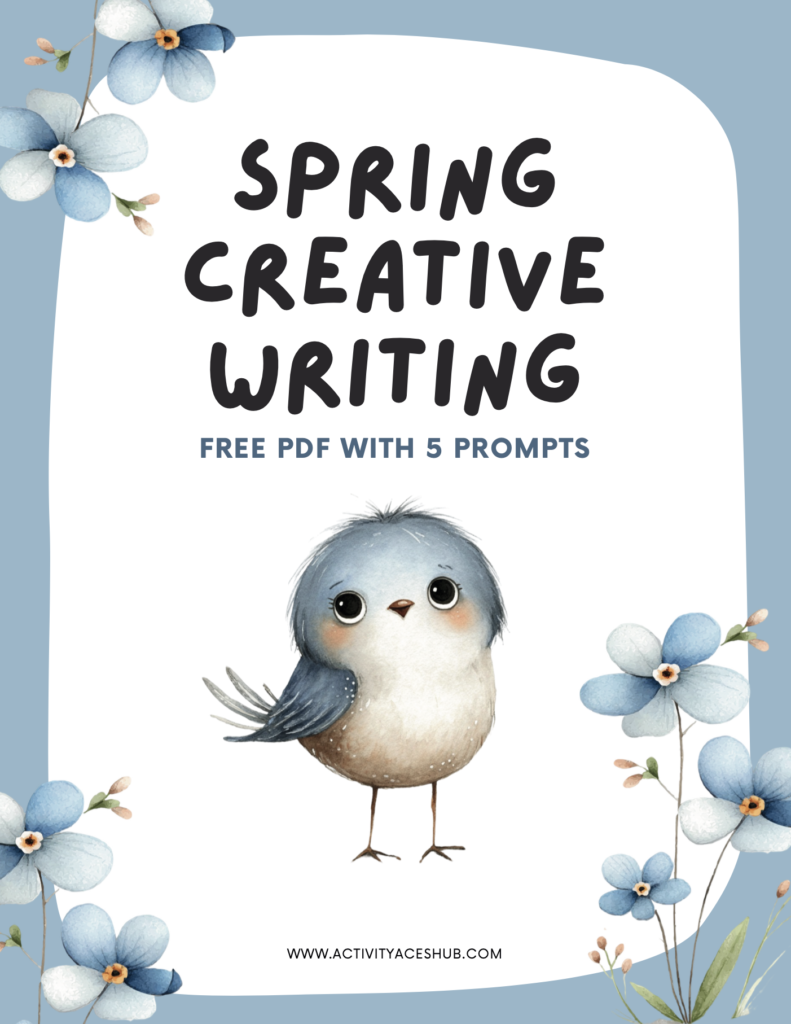
Free Spring Creative Writing Pack
This 5-page printable writing pack guides kids step by step through character creation, story planning, and structured storytelling — making creative writing feel fun, not intimidating.
Ideal for ages 7–12 who need a little structure to turn imagination into a full story.
Perfect for quiet afternoons, homeschool writing blocks, or classroom centers.
Free Spring Coloring Pages
This calming 5-page coloring set includes detailed spring-themed illustrations designed to improve fine motor skills, focus, and emotional regulation.
Great for screen-free downtime, rainy days, and transitions between activities.
A simple way to encourage calm, creative engagement.
Free Spring Maze Pack
This printable maze pack includes 36 fun puzzles across three difficulty levels, helping kids gradually build focus, problem-solving skills, and visual tracking.
Perfect for ages 6–12, the mazes start easy and become more challenging — keeping kids engaged while strengthening patience and logical thinking.
Great for quiet afternoons, homeschool activities, classroom centers, travel time, or rainy day brain breaks.
How to Keep Kids Off Screens During Spring Break
Instead of removing screens completely, replace them with structure.
Try this rotation:
- 20-minute brain challenge
- Outdoor movement
- Creative craft
- Quiet printable time
Short cycles prevent resistance and keep motivation high.
Are Word Searches Educational?
When designed thoughtfully, yes.
They:
– strengthen spelling
– improve visual scanning
– support pattern recognition
– build perseverance
Longer word versions (6–8 letters) are especially effective for ages 9–12.
Final Thoughts
Spring is a season of growth — and that includes mental growth.
The best spring brain activities for kids are structured, engaging, and just challenging enough to spark determination.
Start small. Stay consistent. Watch curiosity grow.